You Know Too Much—and It’s Hurting You
You’re not surrounded by fools — it’s the curse of knowledge.
 Michael Greenspan · August 15, 2025 · 3 min read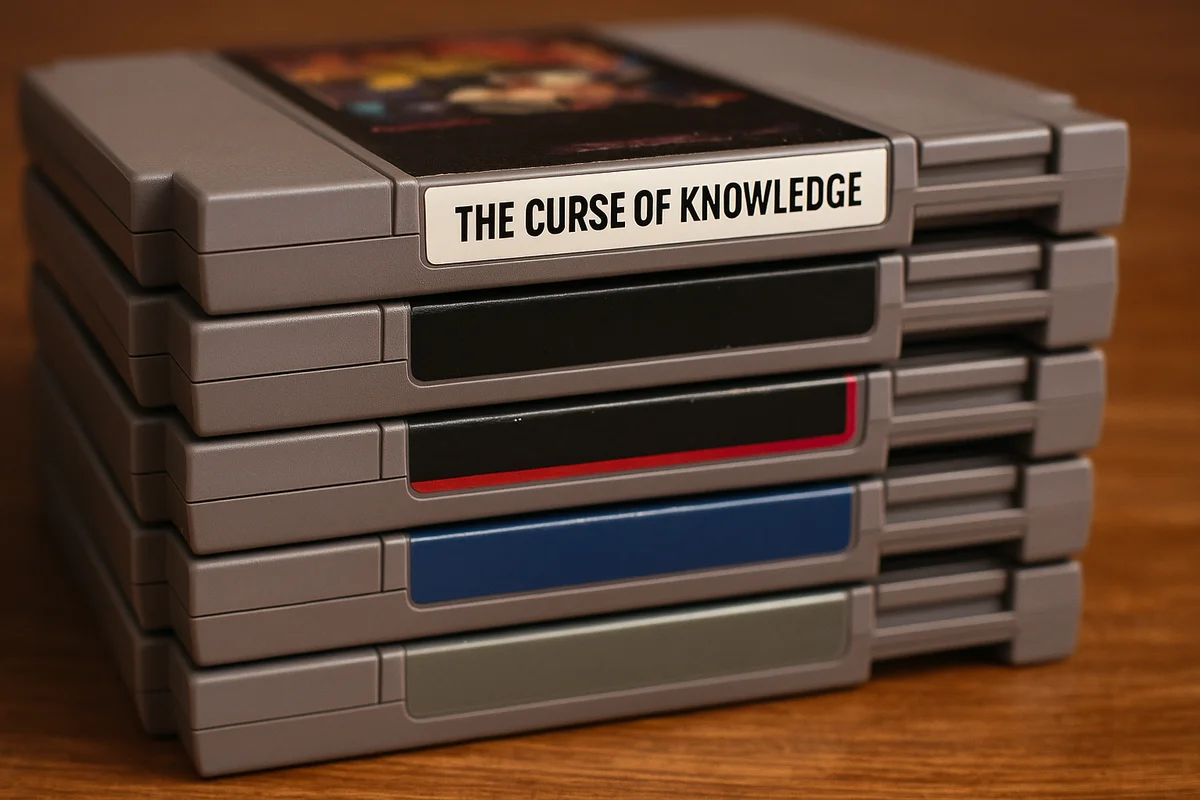
An engineer on your team just gave you a blank stare.
It’s not because they’re slow.
It’s not because they weren’t paying attention.
It’s because you’ve been hit by the curse of knowledge.
Once you’ve mastered something, it’s almost impossible to remember what it’s like not to know it.
So you skip steps without realizing it.
You leave out details that feel “obvious” to you — but are invisible to someone who hasn’t walked your path.
At best you’re puzzled as to why the point didn’t land.
At worst, you are frustrated, indignant, and feel like you are surrounded by imbeciles. “Why don’t they get it?!”
My First Encounter with the Curse
I first met the curse of knowledge as a kid, sitting cross-legged in front of my NES.
(History digression: NES = the original Nintendo. Renting a game = going to a place called a “video store” to borrow a physical copy for one to seven days. Games came on plastic cartridges, and each of us had our own special way of blowing on them to magically fix them when the system wouldn’t boot up 😂).
I’d rent a game and spend a few hours figuring out the controls, the mechanics, the hidden tricks.
Then a friend would come over to play.
They’d start asking questions:
“How did you do that move?”
“What button should I press?”
And the smug little smarty I was, I’d look at them with condescending annoyance:
Well, I figured it out — so you can too.
I didn’t realize it then, but I was deep in the curse.
I had forgotten how confusing it was the first time I held that controller.
How the Curse Shows Up at Work
Fast-forward to your engineering team.
The same thing happens when you’ve been living with a system, a codebase, or a business process for years:
-
You explain in shorthand because the long version feels tedious.
-
You assume they’ll “fill in the gaps” the same way you would.
-
You mistake silence for understanding.
The result?
Frustration and impatience when people ask for more clarity.
Confusion hiding under nods and “Got it.”
Trust erodes.
And along with that, your opportunities to increase your impact fade away.
How to Break the Curse
1. Acknowledge the curse.
You were once a beginner too.
Concepts that feel second nature now were once clumsy, confusing, and foreign.
(Think back to the first time you opened your current codebase — what confused you then?)
2. Replace frustration with empathy.
You’re not surrounded by imbeciles — you’re surrounded by people with different starting points, learning styles, and speeds.
Your annoyance won’t make them learn faster.
(Instead of sighing, ask, “What part feels unclear so far?”)
3. Communicate for their brain, not yours.
Explain patiently. Use different examples. Break it down in multiple ways.
Because what worked for you may not work for them.
And hearing something once is rarely enough for it to stick.
(Have them re-explain the idea in their own words — it’s the quickest way to spot gaps.)
Why This Matters Most for Seniors and Leaders
The higher you climb, the worse the curse gets.
Because the gap between your experience and theirs only grows.
If you don’t actively bridge it, you’ll keep losing time, energy, and trust to preventable misunderstandings.
This is the kind of thing I work through with clients in engineering leadership coaching — the leadership problem hiding inside an everyday technical one.
Next time you see that blank stare, remember:
It’s not a sign of incompetence.
It’s a signal that you’ve forgotten what it’s like to be on the other side of your own expertise.
Pause.
Ask.
Bridge the gap.
Because knowing too much isn’t the problem —
forgetting what it’s like not to know is.